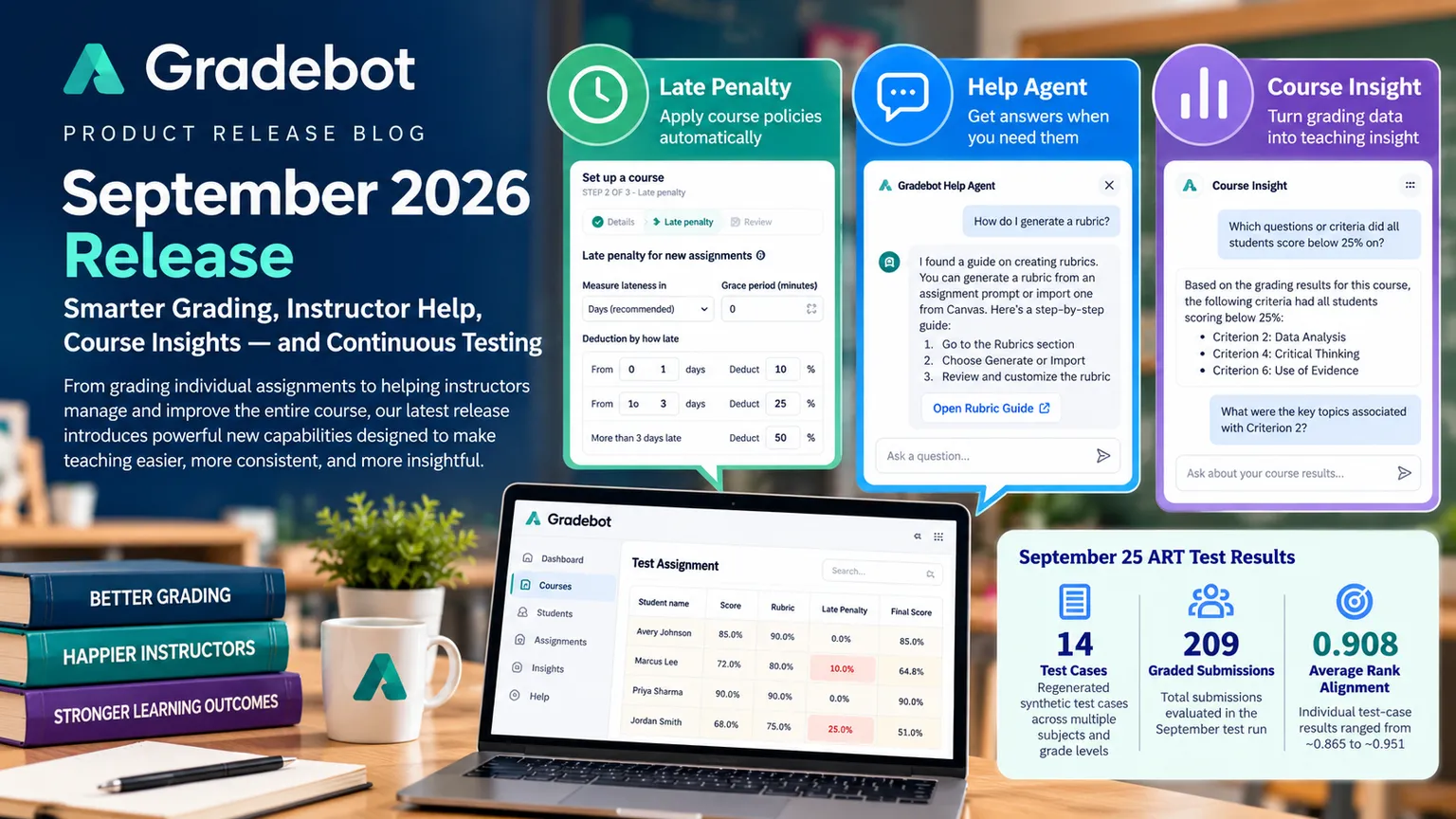
Smarter Grading, Instructor Help, Course Insights - and Continuous Testing
PRODUCT RELEASE BLOG | SEPTEMBER 2026
From Grading Individual Assignments to Helping Instructors Improve the Entire Course
Gradebot's September 2026 release expands the platform beyond AI-assisted grading with new capabilities designed to make the instructor workflow easier, more consistent, and more insightful.
This release introduces three major capabilities: Late Penalty, a new Help Agent, and Course Insight capabilities that help instructors learn from Gradebot grading results at the class level. We have also made a number of usability improvements across the product.
Just as importantly, these capabilities are being released alongside continued investment in Gradebot's testing and evaluation framework. Gradebot is designed around rubric-aligned, explainable, instructor-controlled grading, with AI-generated scores and feedback remaining reviewable and editable before publication to students.
What's New in the September Release
1. Late Penalty: Make Course Policies Part of the Grading Workflow
Late submissions are a routine part of teaching, but applying late policies consistently across dozens - or hundreds - of submissions can create significant administrative work.
The new Late Penalty capability allows instructors to configure the late-submission policy when setting up a course. The release interface supports recommended or custom deduction ranges, a grace period, and the course deadline time zone. An example policy shown in the release is:
· Up to 1 day late: 10% deduction
· More than 1 day and up to 3 days late: 25% deduction
· More than 3 days late: 50% deduction
Once an assignment is graded, Gradebot displays the applicable late penalty alongside the grading results. Instructors can see how the penalty was applied and retain the ability to edit submission time, remove the penalty, or change the deduction.
This extends Gradebot beyond automating academic evaluation: it also helps instructors apply the course policies surrounding that evaluation in a transparent and repeatable way.
2. Help Agent: Getting Answers Where Instructors Need Them
As Gradebot adds capabilities, instructors should not have to search through documentation every time they have a question. The September release introduces a Gradebot Help Agent designed to provide conversational assistance within the Gradebot experience.
The Help Agent is built in stages. It can use Gradebot's internal Help Center knowledge, check preferred Gradebot website sources for information such as pricing or company information, and escalate a question to human support when the available sources cannot answer it reliably.
This reflects an important design principle: the objective is not for AI to answer every question. It is to use the appropriate source or tool for the question and recognize when human assistance is required.
3. Course Insight: Turning Grading Data into Teaching Insight
One of the most important additions to the Help Agent is Course Insight. Traditional grading systems primarily tell an instructor how an individual student performed. Once Gradebot has evaluated a class against a common rubric, that grading data can also help instructors identify where the class struggled.
For example, an instructor can ask which rubric questions or criteria had every student scoring below a chosen threshold. Gradebot can examine the class results and identify the corresponding criteria. The instructor can then ask about the key topics associated with a low-performing criterion.
Course Insight grounds this analysis in the actual rubric and Gradebot grading results. Its tools retrieve criterion-level score statistics, the rubric's descriptions, and student rationale text so recurring themes can be summarized from real grading evidence rather than invented from general knowledge.
The resulting feedback loop is simple but powerful: Teach -> Assign -> Grade -> Analyze -> Improve.
4. Usability Improvements Across Gradebot
The September release also includes a range of usability enhancements focused on the everyday instructor experience. Together, these improvements reduce friction as instructors move from course setup to assignment submission, AI-assisted grading, instructor review, and class-level insight.
Testing the September Release
New functionality matters only if instructors can depend on the underlying grading system. Our September testing builds on Gradebot's established V-Model testing and ART (Adaptive Robustness Test) evaluation framework.
The V-Model foundation validates Gradebot's multi-agent pipeline through unit/component and end-to-end integration testing. ART[1] then addresses the harder question of grading quality using multiple semantic measures, including Rank Alignment, Semantic Distance, Explainability Quality, Rubric Alignment, and optional Study Guide Alignment.
September 25 ART Test Run
14 | 209 | 0.908 |
Regenerated test cases | Graded submissions | Average Rank Alignment |
The September 25 workbook contains 14 regenerated synthetic test cases representing 209 graded submissions. Across those cases, the average final Rank Alignment is approximately 0.908, with individual test-case results ranging from approximately 0.865 to 0.951.
Rank Alignment measures how close Gradebot's numeric score is to the expected expert score: Rank Alignment = 1 - |Gradebot Score - Expected Score| / 100. A value of 1.0 represents identical scores. It measures score closeness, not ordering.
The September test run also reports Explainability, Rubric Alignment, Study Guide Alignment, and Semantic Distance. These provide complementary signals rather than reducing grading quality to a single number.
Testing the Test Data
A particularly useful lesson from the September cycle is that evaluating an AI grading system also requires evaluating the test harness itself. When Gradebot differs substantially from an expected score, either Gradebot may be wrong or the synthetic submission may not honestly deserve the target score.
The September process therefore included rubric-based review of flagged files. When a synthetic submission could not honestly earn its target, the test data could be revised. When the submission did deserve its target, the file was kept unchanged and the difference was recorded as a Gradebot grading error. The workbook explicitly documents these retained Gradebot errors as well as data issues and honest target gaps.
This distinction makes the test harness more useful: its purpose is not merely to produce a high accuracy number, but to reveal where the product is wrong, where the test data is wrong, and what needs to improve next.
From AI Grader to Instructor Intelligence
The September release represents an important evolution in Gradebot. Late Penalty helps instructors consistently apply course policy. Help Agent helps instructors find answers using the right source. Course Insight turns class results into evidence instructors can use to understand learning patterns. Continued ART testing provides a measurable process for identifying both product and test-data improvements.
Use AI not simply to automate grading, but to help instructors understand, manage, and continuously improve the learning experience. |
What Comes Next
Our September release is another step in making Gradebot an intelligent teaching assistant rather than simply an automated grader. We will continue expanding instructor-facing capabilities while applying the same testing philosophy to each release: measure it, inspect the failures, improve the product, and test again.
Want to see the September release in action? Visit Gradebot.ai or
Request a Gradebot demo — Gradebot-demo-link
Get in touch with our team —Email us at support@gradebot.ai or Call us 1-949-781-9165
[1] Please refer to our earlier blog on our testing methodology - Inside the Test Harness:
How We Validated Gradebot's Grading Accuracy